You are here: Home » Blogs » How Does A Servo Motor Work? Complete Beginner's Guide
How Does A Servo Motor Work? Complete Beginner's Guide
Views: 0 Author: Site Editor Publish Time: 2026-06-08 Origin: Site
Ever wondered how robots move so precisely? Servo Motor motors make this possible. They control position, speed, and angle with great accuracy.
Servo motors are vital in robotics, automation, and many modern devices. Understanding how they work can unlock new project possibilities.
In this post, you’ll learn what a servo motor is, why it’s important, and how it operates with precision and control.
Table of Contents
Toggle
How Does a Servo Motor Work?
Basic Operating Principle of Servo Motors
A servo motor works by moving its shaft to a precise position, speed, or angle based on commands it receives. Unlike regular motors that just spin continuously when powered, a servo motor constantly checks its actual position and adjusts until it matches the desired target. This is possible because it uses a closed-loop control system. Think of it as a smart motor that knows exactly where it is and where it needs to be.
Closed-Loop Feedback System Explained
The heart of a servo motor’s accuracy lies in its closed-loop feedback system. Here’s how it works:
The controller sends a command signal telling the motor where to go.
A position sensor inside the motor measures the current shaft position.
The control circuit compares the actual position to the command.
If there’s any difference (called an error), the motor adjusts its movement.
This loop repeats constantly until the motor reaches and holds the target position.
This feedback loop ensures the motor corrects itself instantly, making it ideal for applications requiring precision.
Role of Pulse Width Modulation (PWM) in Servo Control
Pulse Width Modulation, or PWM, is the method used to tell the servo motor how far to turn. It works like this:
The controller sends a series of electrical pulses through the control wire.
The length of each pulse (pulse width) determines the desired position.
For example, a 1.5 ms pulse might command the motor to the center position.
Shorter pulses move it one way; longer pulses move it the other.
These pulses repeat regularly (about every 20 milliseconds) to keep the motor in position.
PWM lets the motor know exactly how much to move, and how fast, by changing the pulse width.
Proportional Control and Motor Speed Adjustment
Servo motors don’t just move to a position; they also control how fast they get there. This is called proportional control:
The motor’s speed depends on the difference between current and target positions.
If the motor is far from the target, it moves quickly.
As it nears the target, it slows down to avoid overshooting.
Once it reaches the desired spot, it holds steady.
This approach saves energy and reduces wear because the motor only works as hard as needed.
Note: Understanding PWM signals and the closed-loop feedback system is essential for designing or troubleshooting servo motor applications in automation and robotics.
Main Components of a Servo Motor
Understanding the main parts of a servo motor helps reveal how it achieves such precise control. Each component plays a key role in the motor’s ability to move exactly as commanded.
Motor Types: AC vs DC Servo Motors
Servo motors come mainly in two types: AC and DC.
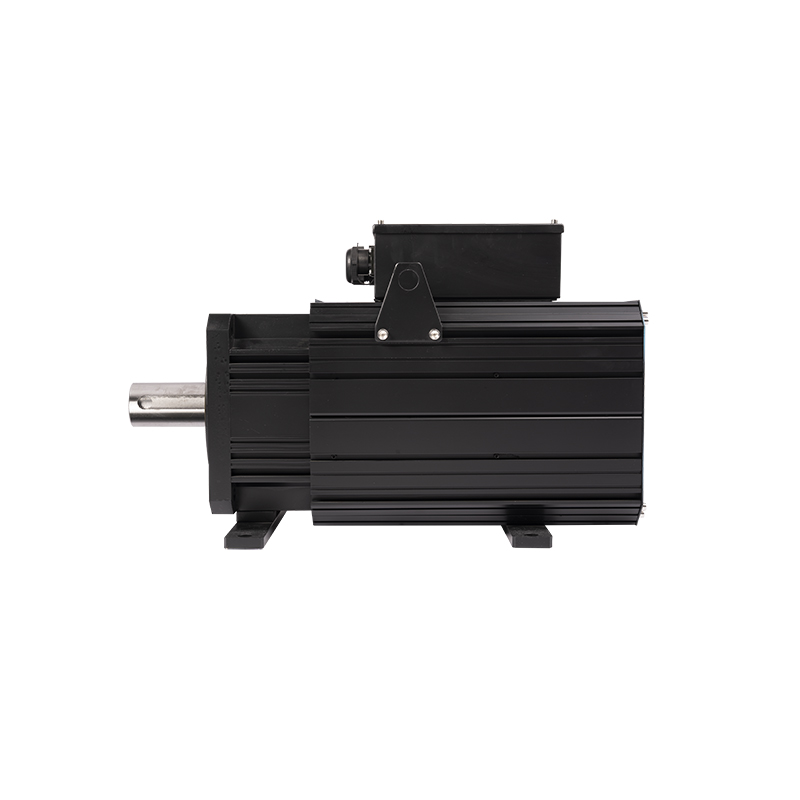
AC Servo Motors run on alternating current. They’re powerful and handle high torque well. You’ll find them in industrial machines like CNC mills and robotic arms. They excel at smooth, continuous operation and high-speed performance.
DC Servo Motors use direct current. They’re simpler, lighter, and often cheaper. These motors suit smaller projects like robotics, drones, or hobby applications. While they don’t match AC motors in power, they respond quickly and are easier to control.
Choosing between AC and DC depends on power needs, precision, and cost.
Position Sensors: Potentiometers and Encoders
Position sensors tell the servo motor where its shaft currently is. This feedback is crucial for accuracy.
Potentiometers are common in hobby servos. They measure shaft angle by changing resistance. Simple and inexpensive, they provide analog signals.
Encoders offer more precise digital feedback. They count shaft rotations and direction, ideal for industrial or high-accuracy uses. Types include optical and magnetic encoders.
Sensors feed real-time position data back to the control circuit to keep the motor on target.
Control Circuit and Its Function
The control circuit acts as the brain of the servo motor. It compares the desired position from the input signal with the actual position from the sensor.
If the two don’t match, it sends commands to the motor to correct the error.
It manages motor speed and direction using proportional control.
It processes Pulse Width Modulation (PWM) signals for precise positioning.
This circuit ensures the motor continuously adjusts until it reaches and holds the target position.
Gear Assembly and Torque Enhancement
Gears inside the servo motor reduce the motor’s speed while increasing torque.
The motor’s shaft connects to a gear train.
This setup multiplies torque, allowing the servo to move heavier loads.
It also helps control the shaft’s position more finely by reducing output speed.
Gears make the servo compact yet powerful, suitable for various applications.
Power Supply Requirements
Servo motors need a stable power source to operate correctly.
The motor and control electronics require a specific voltage, often between 4.8V and 6V for hobby servos.
Industrial servos need higher voltages and currents depending on size and load.
Proper power ensures the motor can deliver torque without stalling or overheating.
Power supply quality affects servo performance and longevity.
Note: Selecting the right combination of motor type, sensor, and control circuit is essential to match your servo motor to your project’s precision, speed, and torque needs.
Types of Servo Motors
Servo motors come in different types, each suited for specific tasks and environments. Understanding these types helps you pick the right one for your project or application.
AC Servo Motors: Characteristics and Applications
AC servo motors run on alternating current (AC). They are powerful and designed for high-performance industrial use. Here’s what makes them stand out:
High Torque and Speed: They deliver strong torque even at high speeds, making them ideal for heavy-duty machinery.
Smooth Operation: Their design ensures smooth, continuous rotation without jerks or vibrations.
Durability: Built to withstand demanding environments and long operational hours.
Precision: Equipped with high-resolution encoders for exact position feedback.
Applications: You’ll find AC servos in CNC machines, robotic arms in factories, automated assembly lines, and industrial welding robots. They handle tasks requiring both power and precision.
DC Servo Motors: Features and Use Cases
DC servo motors operate on direct current (DC). They are simpler, lighter, and often more affordable than AC servos. Key features include:
Quick Response: They react fast to control signals, which is great for dynamic movements.
Ease of Control: Simpler electronics make them easier to set up and maintain.
Compact Size: Their smaller size fits well in tight spaces or lightweight applications.
Use Cases: DC servos are popular in small robots, camera gimbals, drones, and light automation systems. They suit projects where speed and responsiveness matter more than heavy torque.
Radio-Controlled (RC) Servos for Hobby Projects
RC servos are compact, all-in-one units combining a motor, gears, sensor, and control circuit inside a small case. They use a potentiometer for position feedback and are controlled by PWM signals.
Affordable and Easy to Use: Perfect for beginners and hobbyists.
Limited Torque: Not designed for heavy loads but sufficient for small robots and RC vehicles.
Fixed Rotation Range: Usually about 180°, suitable for steering or arm movement.
Examples: RC servos power remote-controlled cars, planes, and DIY robotics kits. They’re great learning tools and work well for light, precise movements.
Choosing the Right Type for Your Application
Selecting a servo motor depends on your project’s needs:
Factor
AC Servo Motor
DC Servo Motor
RC Servo
Power & Torque
High, suitable for heavy-duty tasks
Moderate, for light to medium loads
Low, best for small-scale use
Precision
Very high with advanced encoders
Good, with simpler sensors
Basic, potentiometer feedback
Cost
Higher, industrial-grade
Moderate, affordable
Low, budget-friendly
Complexity
Requires advanced control systems
Easier to control
Simple plug-and-play
Typical Use
Industrial automation, CNC, robotics
Small robots, drones, light automation
RC vehicles, hobby projects
If your project demands strong power and continuous operation, AC servos are the way to go. For quick, responsive control in smaller machines, DC servos fit well. For hobbyists or educational use, RC servos offer simplicity and affordability.
Tip: When choosing a servo motor, always match the motor’s torque, speed, and control complexity to your application’s specific requirements to optimize performance and cost.
Servo Motor Control Systems
Servo motor control systems are what keep everything running smoothly and precisely. They ensure the motor moves exactly as commanded, correcting any errors instantly. Let’s break down how these systems work and the key parts involved.
Closed-Loop vs Open-Loop Control
There are two main ways to control servo motors: open-loop and closed-loop.
Open-Loop Control: The motor receives commands and moves, but there’s no feedback to check if it reached the right position. It’s simple and cheap but less accurate. If the load changes or the motor slips, errors go unnoticed and uncorrected.
Closed-Loop Control: This is the smarter method. The system constantly measures the motor’s actual position using sensors and compares it to the command. If there’s any difference (called an error), it immediately adjusts the motor’s movement. This feedback loop repeats continuously, ensuring high precision. Most servo motors use closed-loop control for accuracy.
Role of Servo Amplifiers and Controllers
The controller and amplifier work together to power and direct the servo motor.
Controller: Think of it as the brain. It sends commands to the motor based on user input or a programmed sequence. The commands specify position, speed, or torque.
Servo Amplifier: The controller’s signals are low power. The amplifier boosts these signals into strong current that can drive the motor. It also regulates how much power the motor gets, controlling speed and torque precisely.
Together, they ensure the motor responds quickly and smoothly to commands, even under changing loads.
Feedback Mechanisms and Error Correction
Feedback is the key to accuracy. Sensors like potentiometers or encoders measure the motor shaft’s position or speed and send this data back to the control circuit.
Potentiometers provide analog signals by changing resistance as the shaft turns. They’re common in hobby servos.
Encoders generate digital signals counting shaft rotations and direction. They offer higher precision and are typical in industrial servos.
The control circuit compares the feedback to the desired position. Any difference triggers correction commands. This error correction happens continuously, allowing the motor to hold steady positions or follow complex motion paths without drifting.
Common Control Signals and Communication Protocols
Servo motors receive control signals in different forms depending on the system:
Pulse Width Modulation (PWM): Standard for hobby and RC servos. The pulse width tells the motor the target position.
Analog Signals: Voltage levels indicate desired speed or torque in some industrial setups.
Digital Protocols: Advanced servo systems use communication protocols like EtherCAT, CANopen, Modbus, or Ethernet/IP. These allow controllers to send detailed commands and receive status updates in real time.
Using these protocols, servo motors integrate seamlessly into complex automation networks, enabling coordinated multi-axis motion and diagnostics.
Tip: For precise control and reliability in your projects, always choose servo systems with closed-loop feedback and matched amplifiers to ensure fast error correction and smooth operation.
Applications of Servo Motors
Servo motors are everywhere, powering a wide range of machines and devices that need precise movement. Their ability to control position, speed, and torque accurately makes them essential in many fields. Let’s explore some of the main applications where servo motors shine.
Robotics and Automation
Robots rely heavily on servo motors to move joints and arms smoothly and precisely. Each joint in a robotic arm uses servos to reach exact angles and hold them steady. This precision is crucial for tasks like assembling electronics or packaging goods. In automation, servos help conveyor belts start, stop, and reverse quickly, keeping production lines efficient and reliable.
CNC Machines and Precision Manufacturing
Computer Numerical Control (CNC) machines use servo motors to guide cutting tools and workpieces with micron-level accuracy. Servos control the position and speed of the tool head, allowing manufacturers to create parts with tight tolerances. Industries like aerospace and automotive depend on this precision for safe, high-quality components.
Industrial Automation and Packaging
In factories, servo motors drive machines that package products, label bottles, or stack boxes. Their fast response and accurate positioning ensure smooth operation and reduce errors. For example, servo-controlled palletizers stack goods perfectly, improving warehouse organization and shipping efficiency.
Mini Robots and Educational Kits
Mini robots, like those used in schools or research labs, often use small servo motors for movement. Kits such as LEGO MINDSTORMS include servos to teach coding and robotics basics. These compact servos provide enough torque to move small parts while being easy to control and program.
Consumer Electronics and Smart Devices
Servo motors also appear in everyday gadgets. Cameras use them for autofocus and zoom functions, delivering smooth and quick lens adjustments. Smart home devices like automated blinds or robotic vacuum cleaners use servos to perform precise movements, enhancing convenience and functionality.
Tip: When selecting servo motors for your application, consider the required precision, speed, and torque to ensure optimal performance and efficiency in your system.
Advantages and Limitations of Servo Motors
Servo motors offer many benefits, making them popular in precision control applications. However, they also come with some drawbacks that users should consider.
High Precision and Repeatability
One of the biggest advantages of servo motors is their ability to position and move with high accuracy. Thanks to the closed-loop feedback system, they constantly check their position and correct errors instantly. This makes them perfect for tasks requiring repeatable, precise movements like robotic arms, CNC machines, and automated assembly lines. They can hold steady positions even under external forces, ensuring consistent results every time.
Energy Efficiency and Compact Design
Servo motors only draw the power needed to reach and maintain their target position or speed. This proportional control saves energy compared to motors that run at full power continuously. Their compact size, often achieved by integrating gears and sensors inside the motor housing, allows them to fit into tight spaces. This combination of energy efficiency and small footprint makes servo motors ideal for applications where space and power consumption matter.
Cost and Complexity Considerations
While servo motors provide excellent precision, they tend to be more expensive than standard motors. The added cost comes from the integrated sensors, control circuits, and sometimes complex gearing. Additionally, setting up and tuning servo systems requires technical knowledge, especially for industrial applications. The control electronics must be properly configured to avoid instability or poor performance. For beginners or simple projects, this complexity can be a barrier.
Torque Range and Suitability for Heavy-Duty Tasks
Servo motors generally excel in applications requiring precise control rather than sheer power. Many servo motors, especially hobby or RC types, have limited torque and are not suitable for heavy-duty loads. Industrial servo motors can deliver higher torque but often at a higher cost and increased size. For extremely heavy or continuous high-torque tasks, other motor types like induction motors or hydraulic actuators might be more appropriate.
Maintenance and Calibration Needs
Servo motors rely on sensors and electronics that can drift or degrade over time. Regular calibration ensures the feedback system remains accurate. In harsh environments with dust, moisture, or vibration, sensors and control circuits may require more frequent maintenance. Additionally, the gears inside the servo can wear, affecting precision and torque. Proper maintenance routines extend the motor’s life and maintain performance but add to overall system upkeep.
Tip: When selecting servo motors for your projects, balance precision needs against cost, complexity, and torque requirements to find the best fit for your application.
Conclusion
Mastering servo motor technology involves understanding their precise control through closed-loop feedback and PWM signals. These motors excel in accuracy, energy efficiency, and compact design, suitable for robotics and industrial automation. Future trends focus on smarter, more integrated systems enhancing performance and connectivity. Grasping servo motor basics empowers you to optimize your projects with better precision and reliability. www.laeg-en.com Laeg Electric Technologies offers advanced servo solutions designed to deliver superior control and efficiency, adding real value to your applications.
FAQ
Q: What is a servo motor and how does it work?
A: A servo motor is a precise control motor that moves its shaft to a specified position using a closed-loop feedback system, constantly adjusting based on position sensor input to match commands.
Q: Why are servo motors preferred in robotics and automation?
A: Servo motors offer high precision and quick error correction, making them ideal for tasks requiring accurate position control and smooth motion in robotics and automation.
Q: How much does a typical servo motor cost?
A: Servo motor prices vary by type; hobby RC servos are affordable, while industrial AC servo motors are more expensive due to higher power and precision.
Q: What are common troubleshooting steps for servo motor issues?
A: Check power supply stability, verify sensor feedback signals, ensure correct PWM control signals, and inspect gears and wiring for damage.
Q: How do AC and DC servo motors compare?
A: AC servo motors provide higher torque and durability for heavy-duty tasks, while DC servo motors are lighter, easier to control, and suited for smaller applications.